01
Learning objective
Learn chess pieces, movement, rules, and basic strategy.
Chess fundamentals for beginners — pieces, rules, checkmate patterns, and tournament-ready play across Levels A, B, and C.
Program snapshot
Key structure for Chess Basic — duration, rhythm and age fit at a glance.
3 months
Course duration
2
Weekly classes
24
Total sessions
60 minutes
Session length
5–18 years
Age group
What your child will build through Chess Basic — clear, mentor-led outcomes across the cognitive skills program.
Learn chess pieces, movement, rules, and basic strategy.
Develop critical thinking, concentration, and spatial awareness.
Build patience, perseverance, and sportsmanship through structured play.
The mentor-led methods that make Chess Basic engaging — hands-on, progressive and designed to spark confidence in every session.
Interactive gameplay sessions with guided instruction.
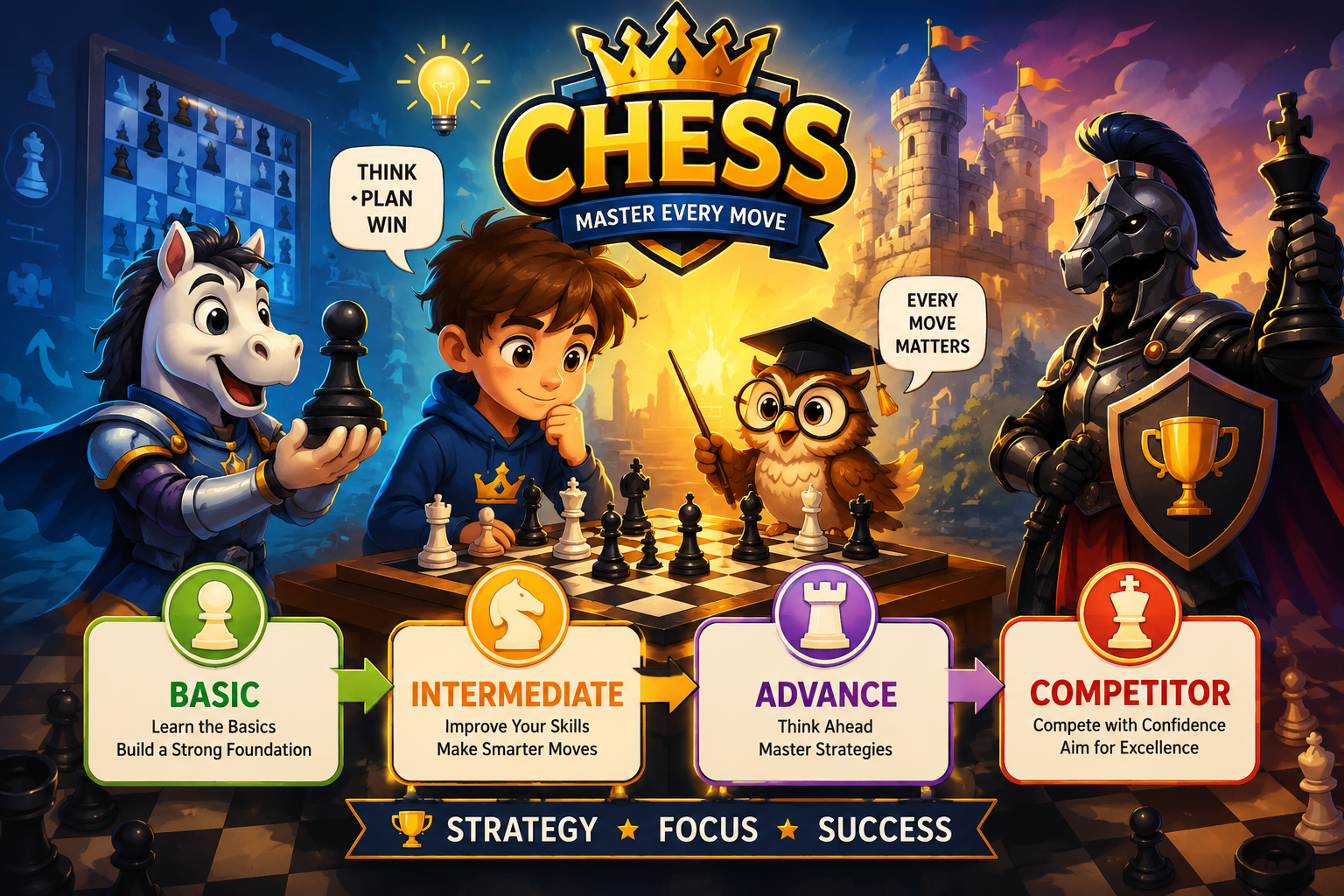
Progressive level-based curriculum (Levels A, B, and C).
Regular playing sessions and free tournaments to apply learning.
Chess Basic builds the whole learner — not just technique, but the motor, cognitive and emotional skills that last beyond the classroom.
Logical reasoning, pattern analysis, and problem-solving through chess.
Sustained attention during gameplay and calculation.
Managing wins and losses with emotional intelligence.
A clear class-by-class path through Chess Basic — what happens in each phase, from the first session to the final review.
Introduction to pieces and coordinates, movement and capturing, check, defending check, checkmate, and pawn promotion.
Revision of all topics, playing session, and free tournament.
Stalemate, defense, checkmate in 1 move, castling, en passant, fair and unfair exchanges, and notations.
Revision, playing session, and free tournament.
Types of draws and wins, touch-and-move rule, king and queen vs king, king and two rooks vs king, basic opening principles, and checkmate in 2 moves.
Revision, playing session, and free tournament.
How mentor progress is tracked throughout Chess Basic — supportive check-ins and clear milestones, not high-pressure tests.
Ongoing evaluation through gameplay and playing sessions.
Free tournaments at the end of each level to assess practical skills.
What learners take away from Chess Basic — skills, confidence and habits that continue well after the final class.
Solid understanding of chess rules, piece movement, and basic tactics.
Ability to play full games and participate in casual tournaments.
Improved numeracy, logical reasoning, and strategic thinking.
Book a free demo with a KidsChaupal mentor and get a personalised learning plan for your child.